How To Draw a Rose?
Here is the step by step process on how to draw a rose.
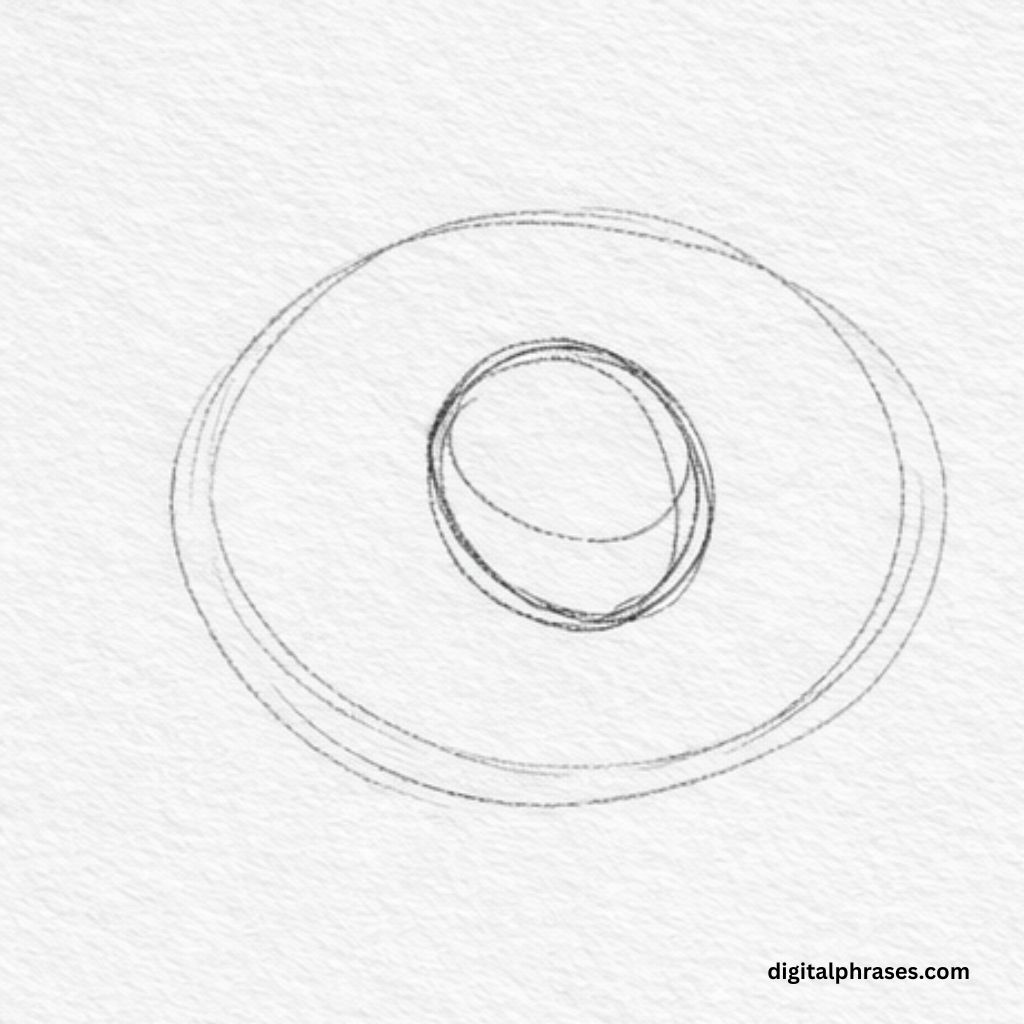
Step 1 – Draw the Guiding Circles for the Rose
- Begin by sketching a large, slightly tilted oval to represent the overall outer boundary of the rose bloom.
- Inside it, draw a smaller circle/oval near the center—this will act as the guide for the tight inner bud.
- Lightly trace the outer oval a second time if needed, so the boundary looks smooth and evenly rounded.
- Keep your pencil pressure very light, because these shapes are only construction guides that will be hidden by petals later.
- Make sure the inner circle sits comfortably within the outer oval, leaving enough space around it for multiple layers of petals.
- Check the tilt of the oval; the slight angle helps the rose look more natural rather than perfectly front-facing.
- Avoid adding petal details yet—this step is purely about setting correct proportions and placement.
Step 2 – Sketch the Inner Bud and First Petals
- Inside the small center circle, draw a tight spiral-like petal fold to suggest the rose’s inner swirl.
- Add a few curved petal shapes wrapping around that spiral, forming the first layer of the bud.
- Use curved, overlapping lines so the petals look like they tuck behind one another rather than sitting side by side.
- Begin extending petals outward toward the boundary of the larger oval, but keep them simple and lightly drawn.
- Let some petal edges curve inward and others flare slightly outward to create a realistic, organic look.
- Use the outer oval as a guide to keep the bloom balanced while still allowing natural asymmetry.
- At this stage, the rose should look like a recognizable bud forming inside the larger shape, but still rough and sketchy.
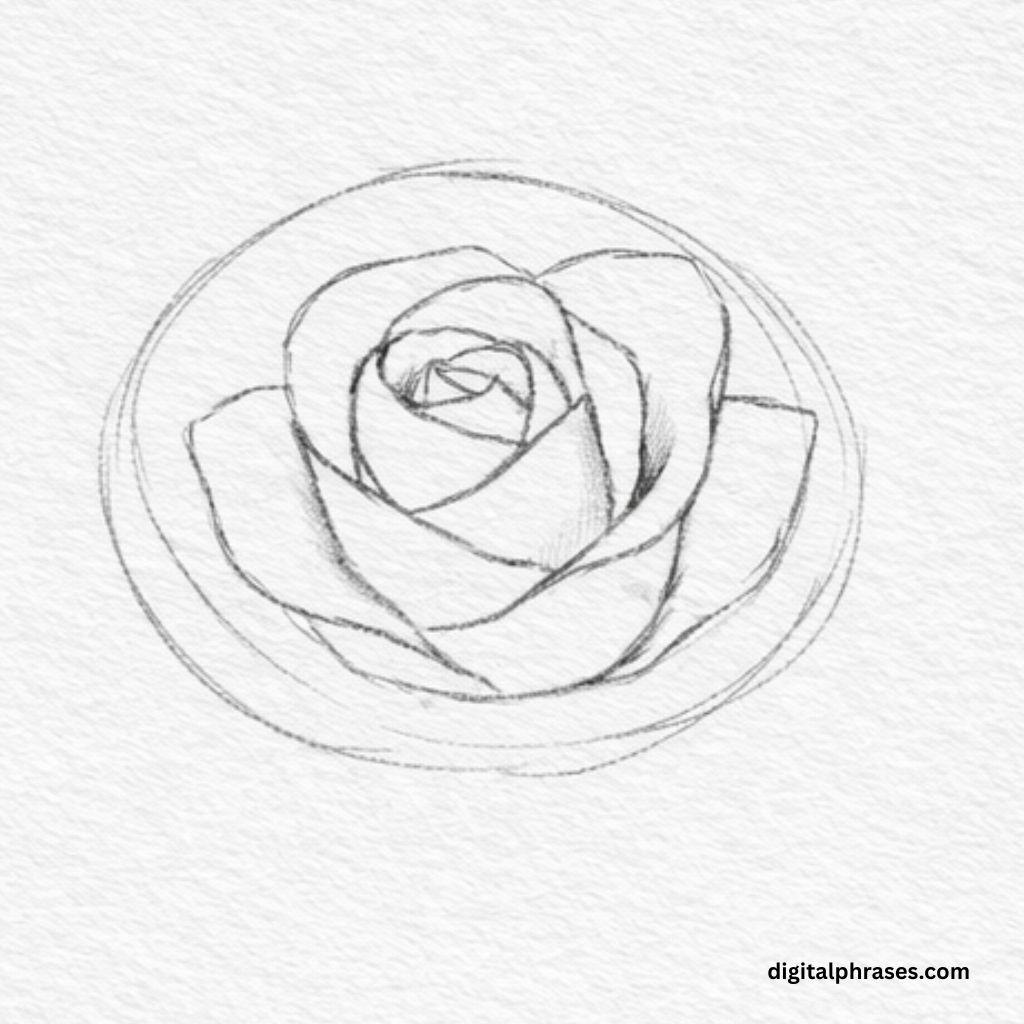
Step 3 – Build the Full Bloom with Outer Petal Layers
- Start drawing the larger outer petals, expanding beyond the bud and reaching toward the edges of the big oval.
- Make each outer petal wider and looser, with gently wavy edges to capture the softness of a real rose.
- Overlap petals clearly: draw the front edge of a petal darker, and let it disappear behind neighboring petals.
- Refine the center swirl by cleaning up the inner folds so the bud looks tighter and more layered.
- Add subtle contour lines inside some petals to show the direction they curve and fold.
- Lightly erase remaining parts of the construction ovals that are no longer needed, keeping only helpful guides.
- By the end of this step, the rose should look like a complete flower bloom in line form, with multiple petal layers and a strong silhouette.
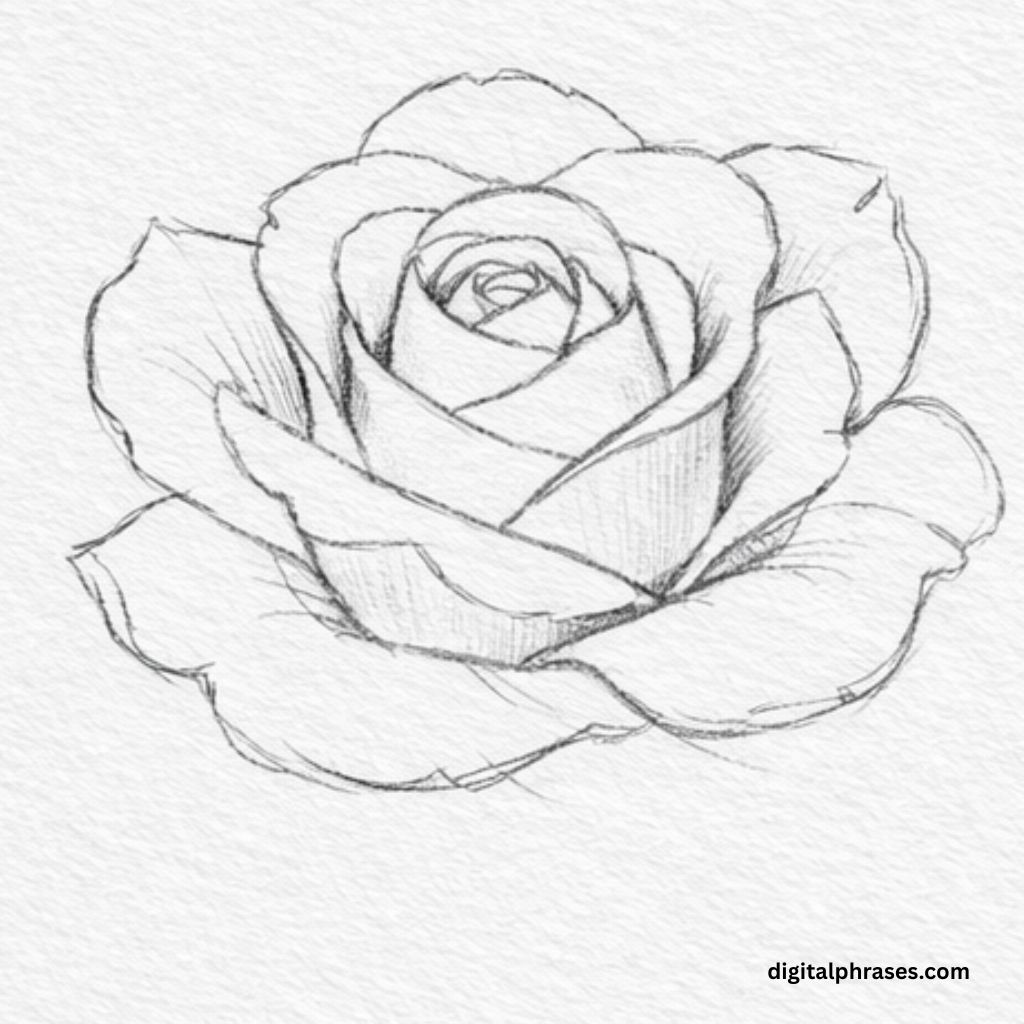
Step 4 – Add Leaves and Shading for a Finished Rose
- Draw a cluster of leaves underneath the rose, using pointed oval shapes with slightly jagged edges.
- Add leaf veins with a central line and smaller branching lines to make them look realistic and textured.
- Begin shading the rose petals: darken areas where petals overlap, especially near the inner folds and under the top edges.
- Use soft pencil shading or light cross-hatching to create gradual transitions, keeping highlights on the upper petal surfaces.
- Deepen the shadows in the center of the rose to emphasize depth and make the swirl stand out.
- Shade the leaves darker than the petals in some areas to separate them visually from the flower.
- Clean up the final outline, erase leftover guidelines, and strengthen the petal edges selectively so the rose looks crisp, detailed, and complete.