How To Draw a Lily Flower
Here are the steps.
Step 1 – Draw the Basic Petal Shape
- Begin by sketching a simple vertical oval or elongated teardrop shape in the center of your page.
- This shape represents the main central petal of the lily and acts as a guide for proportions.
- Keep your pencil pressure very light, as this is only a foundational guideline.
- The shape should be slightly narrower at the top and wider toward the bottom to mimic the natural form of a lily petal.
- Avoid adding details at this stage; focus only on capturing a clean, smooth outline.
- This initial shape helps establish the height, width, and orientation of the flower.
- Make sure the oval is centered properly so there is enough space around it for additional petals later.
- This step trains your eye to start with simple forms before complex details, which is essential for floral drawing.

Step 2 – Add Surrounding Petals
- From the base of the initial oval, draw two to four additional petal shapes extending outward.
- These petals should curve gently and fan out to both sides, creating a balanced, symmetrical look.
- Each petal should have a pointed or softly rounded tip, similar in style to the first petal.
- Overlap the petals slightly to give the flower a layered appearance.
- Use curved lines that flow naturally upward, avoiding sharp or rigid strokes.
- At the bottom, allow all petals to meet at a single point to form the base of the flower.
- Keep the petals fairly simple, without veins or texture at this stage.
- This step defines the overall bloom structure and helps visualize the lily opening.

Step 3 – Refine Petals and Add Depth
- Add more petals behind the front ones to give the flower a fuller and more realistic shape.
- Vary the size and angle of the petals so they do not all look identical.
- Slightly curve some petals inward and others outward to suggest depth and perspective.
- Clean up overlapping lines by erasing unnecessary sketch marks.
- Define the petal edges more clearly while keeping lines soft and natural.
- Begin suggesting subtle folds at the base of the petals using gentle curves.
- Ensure the flower looks balanced and evenly spread on both sides.
- This step transitions the drawing from a simple sketch to a recognizable lily bloom.

Step 4 – Add Details, Stem, and Final Touches
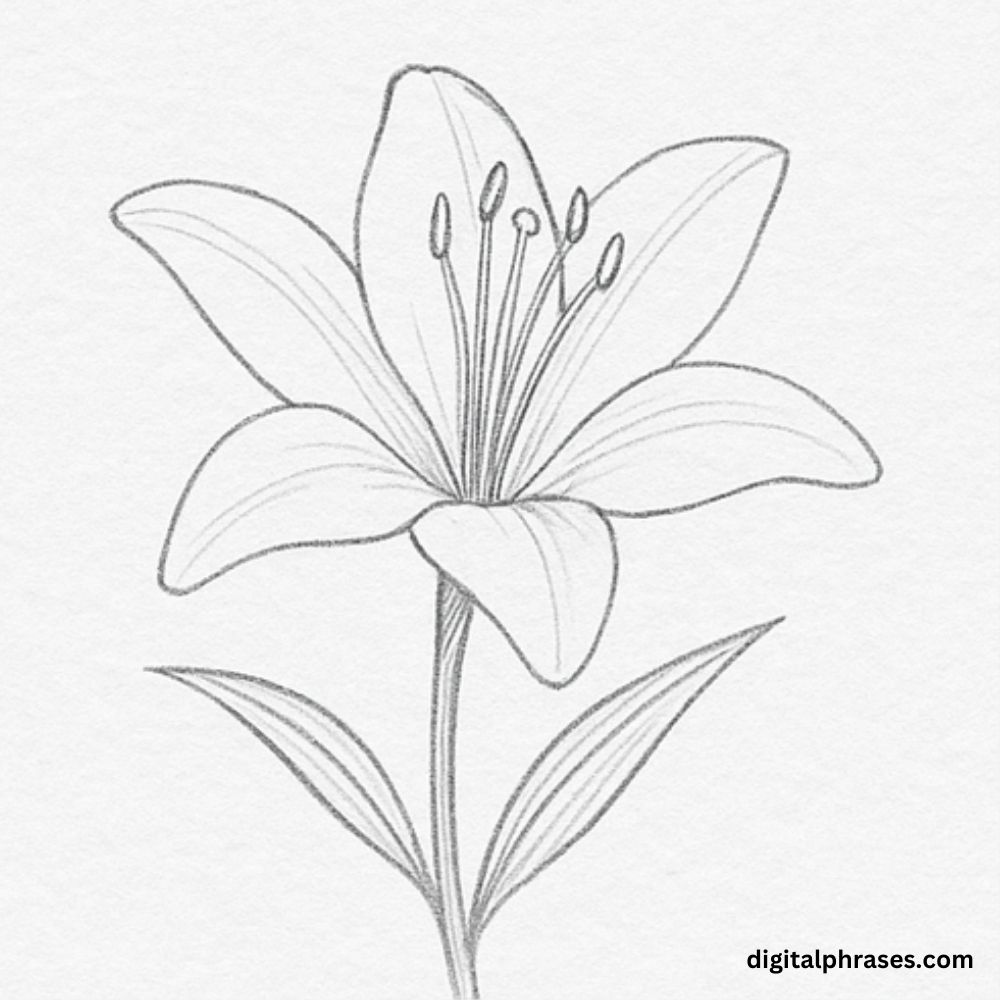
- Draw the stamens in the center of the flower using thin vertical lines topped with small oval shapes.
- Add a slender stem extending downward from the base of the flower.
- Sketch a pair of long, narrow leaves along the stem, tapering to sharp points.
- Add light vein lines inside the petals to enhance realism.
- Thicken or darken important outlines to make the flower stand out.
- Erase any remaining construction lines for a clean finish.
- Optionally add shading near the petal bases to suggest depth and softness.
- This final step brings the lily to life, completing the drawing with structure, elegance, and botanical detail.
By following these four steps carefully, you can confidently create a graceful and realistic lily flower drawing, even as a beginner.