How To Draw a Moon?
Here are the steps towards drawing a realistic moon.
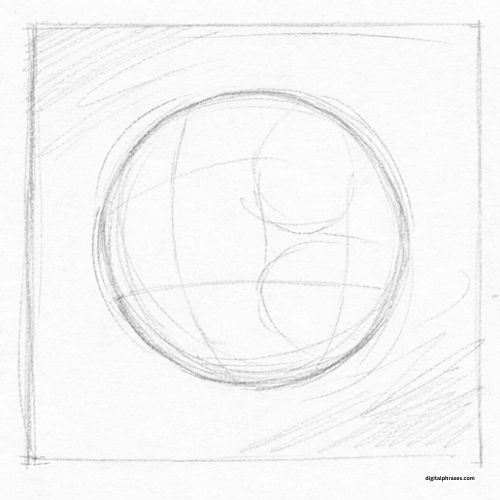
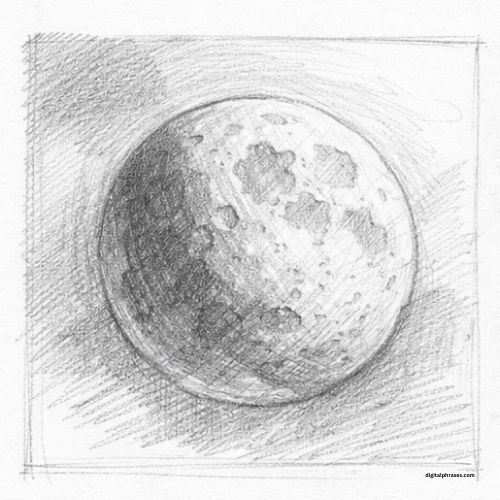
Step 1 – Construct the Basic Shape and Guidelines
- Start by lightly sketching a large circle in the center of your page; this will be the overall shape of the moon.
- Use soft pencil strokes so corrections can be made easily.
- Add a few curved guideline lines inside the circle to suggest the moon’s spherical form.
- These internal curves help you visualize the moon as a 3D object rather than a flat disc.
- Sketch a faint square or rectangular boundary around the moon to frame the composition.
- Lightly shade the background with loose strokes to establish the surrounding space.
- Keep everything very light and sketchy at this stage—no dark shading yet.
- This step focuses entirely on proportion, placement, and spatial planning.
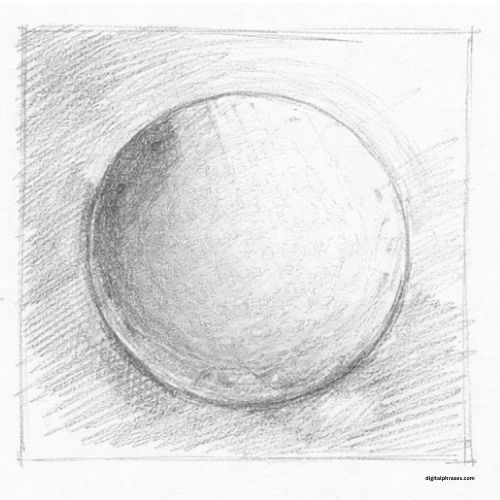
Step 2 – Apply Base Shading and Volume
- Begin shading the moon using smooth, circular pencil strokes.
- Decide on a light source—here, the light appears to come from the upper-right side.
- Gradually darken the left side of the moon to create a soft shadow.
- Leave the brightest area mostly untouched to represent reflected light.
- Add subtle shading just inside the moon’s edge to suggest curvature.
- Extend light shading into the background to create contrast between the moon and space.
- Avoid sharp lines; aim for gentle transitions between light and dark.
- This step gives the moon a rounded, three-dimensional appearance.
Step 3 – Add Surface Texture and Craters
- Start drawing craters by adding irregular circular and oval shapes across the moon’s surface.
- Vary their sizes to make the texture more realistic.
- Shade inside and around the craters to give them depth.
- Darken areas where craters overlap or cluster together.
- Enhance the shadowed side of the moon to increase contrast.
- Blend lightly to keep the surface looking natural and rocky.
- Refine the moon’s edge, keeping it slightly uneven for realism.
- This step transforms the moon from a smooth sphere into a detailed celestial body.
Step 4 – Refine Details and Create the Space Background
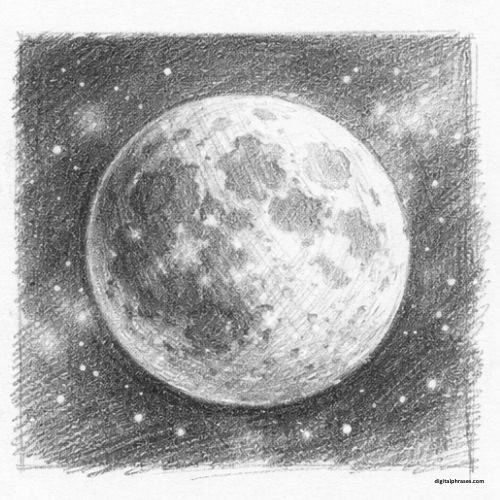
- Deepen the darkest shadows on the moon to strengthen realism.
- Add sharper highlights on the brightest areas to enhance the light source.
- Darken the surrounding background significantly to represent outer space.
- Scatter small stars across the background using tiny dots or light pencil taps.
- Increase contrast between the moon’s rim and the dark sky.
- Blend background shading smoothly while keeping stars crisp.
- Clean up unnecessary sketch lines without removing texture.
- This final step completes the drawing, giving it a dramatic and polished finish.