When to Stop Planning and Start Writing As a Writer
The more we know about storytelling, the harder it gets to actually start writing. Weird, right?
You’d think experience would make us faster, but it often makes us more hesitant.
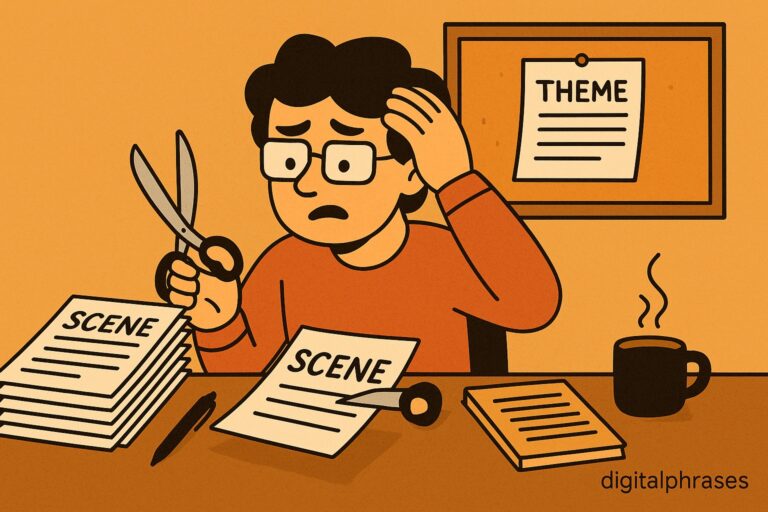
I’ve caught myself obsessing over theme threads, secondary character arcs, and the “perfect” midpoint twist… before writing a single scene.
And if you’re anything like me, you’ve probably told yourself it’s “part of the process.” But here’s the kicker: at a certain point, planning becomes a safety blanket. It feels productive, but it’s a cleverly disguised form of procrastination.
As experienced storytellers, we know too much—and that knowledge can trick us into believing that a better plan will solve everything.
But the truth?
No outline can replace the discoveries that happen mid-draft. Planning is important, yes—but it’s not the story. Let’s dig into that a bit.
What Planning Really Does for a Story (and What It Doesn’t)
When I was a newer writer, I barely planned. I’d dive in with a character and maybe a vague ending, and just go. And honestly? Some of that work sang. Sure, it was messy, but it was alive.
Now?
I can’t unsee the narrative structures, the pacing beats, the theme echoes I want to land by act three. And because I see them, I feel like I need to solve them all before I write a word.
That’s not a flaw—it’s a side effect of knowing how the sausage is made.
Planning becomes more intricate when we understand storytelling at a structural level. We’ve studied three-act, five-act, nested arcs. We know how tone and POV shift emotional resonance.
We get the mechanics—and so, we start treating the story like a machine that must be engineered to perfection.
But stories aren’t machines. They’re living, breathing things that often won’t reveal themselves until you’re deep in the writing.
The Illusion of Control
Here’s where it gets tricky. Planning gives us the illusion of control. It feels safe. Clean. Manageable. You can move sticky notes around or color-code a spreadsheet and feel like progress is happening—even if the story itself hasn’t taken a breath.
I’ve had entire projects where I spent weeks planning character arcs across three books… and never wrote chapter one. The more I refined the plan, the more precious it felt—and the scarier it became to mess it up by actually writing.
You know that feeling? Where your plan is so “tight” that starting the draft feels like throwing mud on a clean canvas?
That’s fear. Not craft.
What Planning Can’t Do For You
Let’s be blunt: planning can’t tell you how your story feels.
It can’t show you if your dialogue works, or if the chemistry between characters crackles, or if your narrator’s voice is alive. You only find those things by writing.
Take Aaron Sorkin, for example. He’s a meticulous planner, but he’s also said in interviews that the rhythm of a scene only becomes clear once the characters start talking. He writes to hear it.
Or consider a novelist like Donna Tartt.
Her outlines are famously detailed, but she still allows massive discovery during drafting. In The Goldfinch, whole characters and subplots evolved after she began writing, not before.
Planning is just one version of the story. The draft is the truth.
So Why Do We Still Plan So Much?
Because we’re trained to think that control equals quality. But that’s not storytelling—it’s engineering. And we’re not engineers. We’re creators of emotion, tension, and surprise.
I’m not saying “don’t plan.” Far from it. I’m saying know what planning is for. It’s scaffolding. It’s guardrails. It helps you not fall off a cliff, but it doesn’t build the damn bridge.
Only writing can do that.
How to Know It’s Time to Stop Planning and Start Writing
Let’s not pretend this part’s easy—deciding when to move from planning to drafting can feel like jumping off a cliff with a half-built parachute. But the thing is, most experienced writers don’t need more structure—they need a reason to let go of it.
So here’s the big question: How do you know when it’s time to start writing?
I’ve put together a list of signals that have shown up not just in my own work, but in conversations with other pros who’ve hit that same moment of paralysis. If you’re nodding at more than a few of these, it’s probably time to put the outline down and open the damn document.
7 Clear Signs You’re Overplanning and Need to Write Already
1. You’ve rewritten your outline more than twice, and the changes are getting smaller.
You’re swapping Act Two beats like puzzle pieces, but nothing major is shifting. That’s a sign you’re polishing the scaffolding, not the story.
2. You’ve fully fleshed out your characters—but they haven’t done anything yet.
You’ve got their enneagram types, their childhood traumas, their favorite flavor of ice cream… but not a single scene of them actually being in the world? Time to let them walk and talk on the page.
3. You’re researching stuff you probably don’t need.
Listen, I once spent an entire week researching ancient Icelandic textiles for one paragraph in a short story. If you’re deep-diving into micro-history before you have a first draft, that’s procrastination wearing a research hat.
4. You keep telling yourself “just one more thing” before you start.
Whether it’s a worldbuilding detail or another pass on the scene list—this is perfectionism, plain and simple. Stories aren’t built in perfect layers. They’re revealed through messy, risky, emotional writing.
5. You’re afraid of ruining your beautiful plan.
This one’s huge. If you’ve fallen in love with your outline so much that the idea of writing feels like a threat to it? That’s the plan becoming a cage. Burn it. Or at least stop treating it like gospel.
6. You’ve explained your story to others more times than you’ve written it.
If your story exists more in conversations than in actual paragraphs, it’s time to shift modes. Talking about story is useful—but it’s not storytelling.
7. You’re itching to write, but keep talking yourself out of it.
Your gut knows. That internal voice saying “just start already” isn’t naïve—it’s wise. Trust that itch. That’s where momentum lives.
You Don’t Have to Know Everything to Start
Here’s something I wish someone had told me sooner: you don’t need the whole plan to begin. You need a strong enough question to chase. That’s what first drafts are for. Discovery. Surprise. Voice.
I know we all have our own thresholds—some of us need a roadmap, others need a flashlight and a dark tunnel. But at some point, the only way forward is the writing itself. The outline won’t save you from the work. And it shouldn’t.
Writing is where story becomes real. Not in theory, not in note form, not on your corkboard.
So if you’re staring at your plan, feeling like you’re “almost there”? You probably already are.
Let Your Draft Be a Partner, Not a Product
Let’s shift perspectives a bit. What if the draft isn’t the result of planning, but the collaborator in it?
That’s a mental reframe that changed my entire approach. For years, I treated drafting as the reward I got after all my meticulous prep work. Like, once everything was perfectly planned, then I could write. But writing doesn’t reward planning. It responds to it.
Your Draft Is Trying to Talk to You—If You Let It
Some of the best story turns I’ve ever written came from a character saying something I didn’t expect—or a scene veering emotionally in a direction the outline hadn’t accounted for. Those surprises? They weren’t accidents. They were the story showing me what it wanted to become.
The truth is, your story will evolve when you give it a voice. That voice comes through sentence structure, pacing, dialogue, rhythm. Not spreadsheets. You can’t feel your story’s emotional pulse in an index card stack.
That’s not a knock on planning tools.
I use them too. But the moment I started treating my first draft like a collaborator, things changed. Suddenly, it wasn’t about executing the plan. It was about reacting to what the writing was telling me.
The “Threshold Draft” Technique
Here’s a tool I’ve started using that might help if you’re stuck between overplanning and not-quite-ready-to-write:
The Threshold Draft.
The idea is simple: once your plan hits 70%, you start writing. Not when it’s 100%. Not when you’ve figured out every act turn. Seventy percent. That remaining 30%? You discover it as you go.
I picked this up from a friend who writes for TV.
In writers’ rooms, you’re never totally ready. You write episodes while still figuring out the season arc. It’s messy—and it works. Because momentum is more powerful than precision.
When I started treating my own fiction that way, everything loosened up. Suddenly, I wasn’t aiming for “perfect”—I was aiming for alive.
A Real-World Example: The Pivot Scene
Let me share a quick moment from one of my own drafts. I was halfway through a planned scene where the protagonist confronts her estranged brother. The outline said “high tension, eventual forgiveness.”
But once I got into the scene—writing it, hearing their voices—I realized… she wasn’t ready to forgive him.
I felt it in the rhythm of her sentences. In the silences between them. I paused, adjusted, let her stay angry. That moment changed the entire second half of the book. The draft told me something the plan couldn’t.
That’s what this is all about. Making space for those discoveries.
Writing Is Not a Test of Planning—It’s an Act of Trust
At the end of the day, you’re not building a story from blueprints. You’re discovering it, layer by layer, beat by beat, moment by moment.
Writing is the only part of the process where the story can truly surprise you. And if there’s no room for surprise, what are we doing?
So let your plan guide you—but not control you. Let your draft answer the plan. That’s where the magic happens.
Final Thoughts
There’s a moment every writer faces where they have to stop thinking about the story and start living inside it.
If you’re there right now, hear this: your story won’t get better just because you planned more. It’ll get better because you wrote it. Because you showed up, trusted your instincts, and let the work unfold.
Planning is powerful.
But writing?
That’s where the story becomes real.
You ready?